A wave of anti-femicide protests has broken out across major Cameroonian cities, including Yaounde and Douala, as thousands of citizens demand that the government take immediate action to protect women. The demonstrations follow a series of violent deaths that have sparked national outrage, most notably the case of Geraldine Achiah, an elementary school teacher in her 30s who died in September, just two months after her wedding.
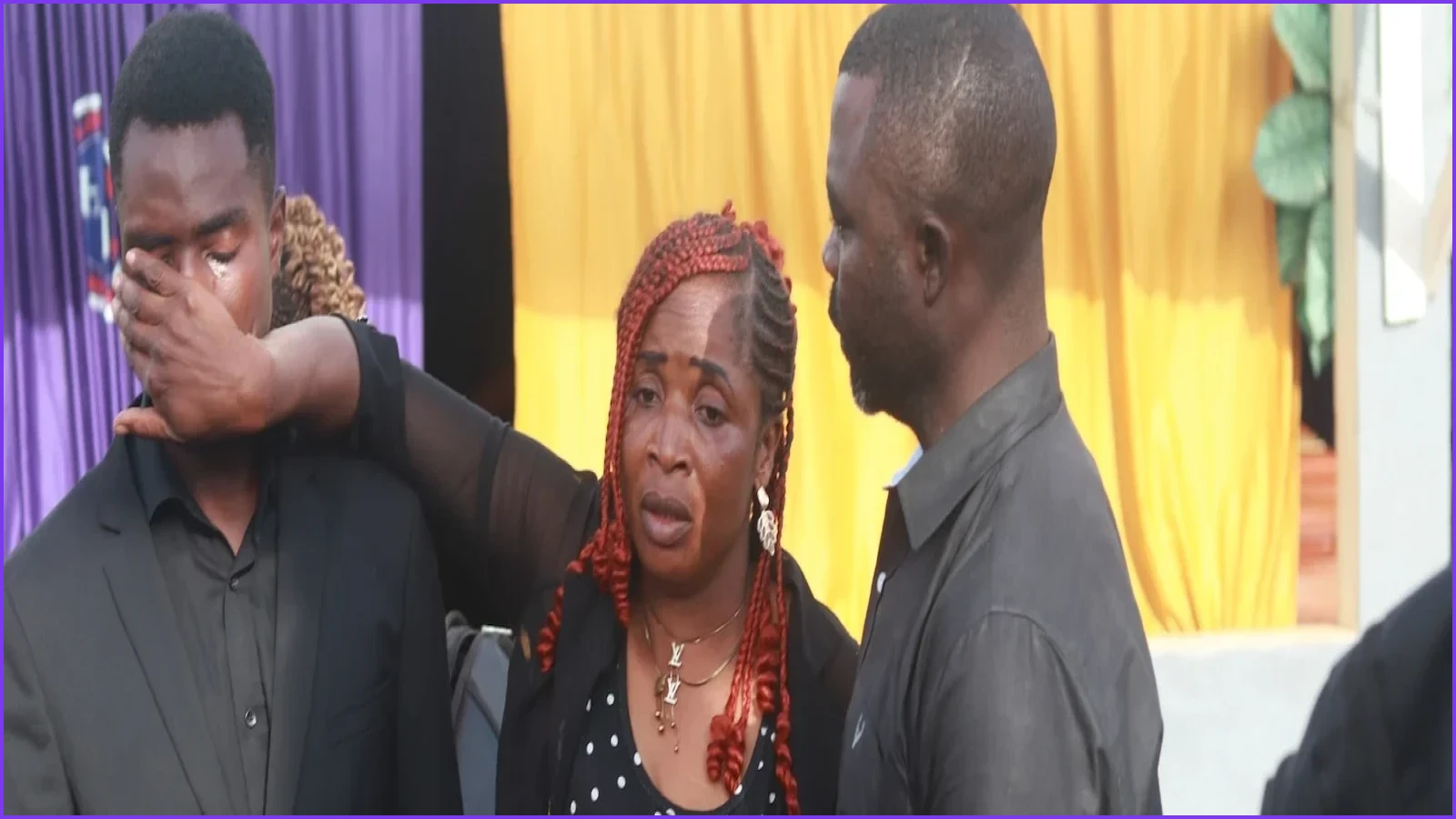
Family and friends recently gathered in Yaounde for her burial, an event that has become a rallying point for those concerned about the safety of women in the country.
Achiah’s relatives allege that she was killed by her husband, Manfred Amambua, following a marital dispute. While Amambua has denied the allegations, he has been charged with murder and remains in jail awaiting trial. Police investigators involved in the case, including officer Ndzana Bienvenu, have gathered evidence including blood-stained bedsheets and phone footage recorded after the alleged beating.
Hospital records obtained by the Associated Press confirmed that Achiah had sustained several visible bruises on her face and lips before her passing.
For Achiah’s family, the loss is devastating. Her 18-year-old son, Courage Abombi, fondly remembers his mother’s support for his dreams of becoming a mechanical engineer. Abombi, who was forced to sit for a university entrance exam just one day after his mother’s funeral, stated that he is praying for justice for her death and that her killer will face the law.
He shared that his mother continues to appear in his dreams, consoling him not to despair. Her cousin, Regina Ngukum, added that the family is seeking justice not only for their daughter but for all victims of femicide, noting that Achiah was a teacher who imparted knowledge on thousands of young Cameroonians.
Women’s Affairs Minister Marie-Thérèse Abena Ondoa has acknowledged the crisis, describing the frequency of such killings as “cruel” and “alarming” during a recent address to the state broadcaster. She noted that the country’s difficult economic situation often forces women to remain in abusive marriages due to limited resources, hoping for change that rarely arrives.
The government is currently working on a new bill intended to define femicide as a standalone criminal offense and to broaden protections against gender-based violence, with expectations that the legislation will be submitted to parliament in November.
However, activists argue that legal reform is only the beginning of a much larger struggle. Currently, Cameroon’s Penal Code recognizes crimes such as rape but lacks explicit provisions for femicide, forcing judges to rely on general homicide laws. This is a common trend across many African countries, where femicide is often addressed through general laws rather than as a distinct offense.
Rights activist Carole Grace Mbarga warned that even existing laws are often undermined by corruption, intimidation, and procedural failures that lead to reduced charges or acquittals. She explained that when investigations drag on, evidence deteriorates, witnesses lose confidence, and families become discouraged.
Furthermore, when convictions do occur, sentencing is frequently viewed as insufficient. In 2025, a man who pleaded guilty to killing his wife received only a suspended five-year sentence and a fine of 52,000 CFA francs, approximately $90.
Protest organizer Laura Sen emphasized that beyond the proposed law, the government must address the systemic barriers that prevent women from escaping violent environments, including social stigma and financial hardship.
For many Cameroonian women, the struggle remains a daily battle against both violence and the lack of institutional support.