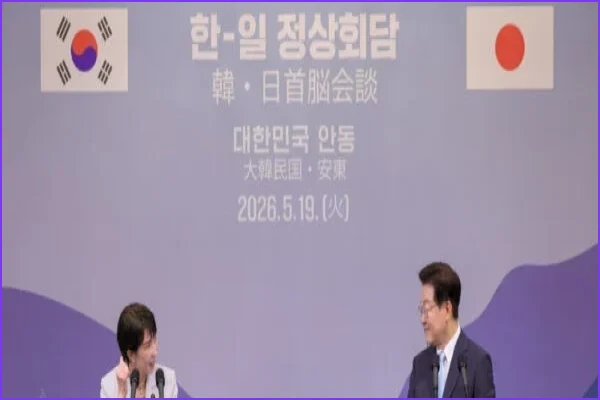
Japanese Prime Minister Takaichi Sanae and South Korean President Lee Jae-myung gathered for a summit meeting in Andong, South Korea, on May 19, 2026, highlighting the evolving nature of the bilateral relationship. While the two nations are increasingly viewed as like-minded partners, their approach to North Korea reveals a significant duality in their respective foreign policies.
On the security front, Tokyo and Seoul share a robust alignment. Both governments have expressed deep concern over North Korea’s expanding nuclear and missile capabilities. There is substantial potential for cooperation in areas such as countering North Korean cyberattacks and illicit cryptocurrency theft. This security collaboration has gained further urgency as the military ties between Russia and North Korea continue to strengthen. Furthermore, both countries find the bilateral Japan-South Korea framework increasingly vital for navigating relations with an unpredictable U.S. administration, often prioritizing this direct connection over the broader trilateral arrangement.
However, these like-minded stances diverge when North Korea is viewed as a potential diplomatic partner rather than a purely military threat. For South Korea, North Korea represents both a security challenge and one half of a divided nation that shares a common language. Regardless of the administration in Seoul, the goal of peaceful coexistence and eventual reunification remains an underlying factor in policy. Conversely, Japan views North Korea as a foreign nation across the sea. Japan’s policy is uniquely constrained by the abduction issue, a factor that makes normalization impossible for Tokyo without meaningful progress, regardless of developments on nuclear or missile issues.
Even when both capitals express support for diplomacy, their expectations differ. Seoul seeks dialogue to reduce inter-Korean tensions, whereas Tokyo requires engagement that addresses its specific outstanding grievances. Even regarding denuclearization, the two sides remain divided on whether to accept a freeze of nuclear capabilities as an intermediate step, with Japan continuing to insist on complete, verifiable, irreversible denuclearization (CVID).
The role of China further complicates these dynamics. While China is North Korea’s primary economic partner, Japan and South Korea hold different views on Beijing. Japan generally perceives China primarily as a long-term security threat, while South Korea views it as both a concern and an essential partner for managing the Korean Peninsula. Because South Korea shares a land border with China, it cannot ignore the geopolitical weight of this relationship, a reality that has occasionally led South Korean leaders to prioritize ties with Beijing over alignment with Tokyo.
Despite these differences, cooperation remains both possible and necessary. History has shown that failures to act in concert only provide North Korea with greater room for maneuver, as Pyongyang has historically sought to drive wedges between Tokyo, Seoul, and Washington. While Japan and South Korea may never adopt identical policies, their ability to manage these differences with steadiness and dexterity will ultimately determine if the label of like-minded partners holds true.
You have reached the limit of 2 free articles this month.