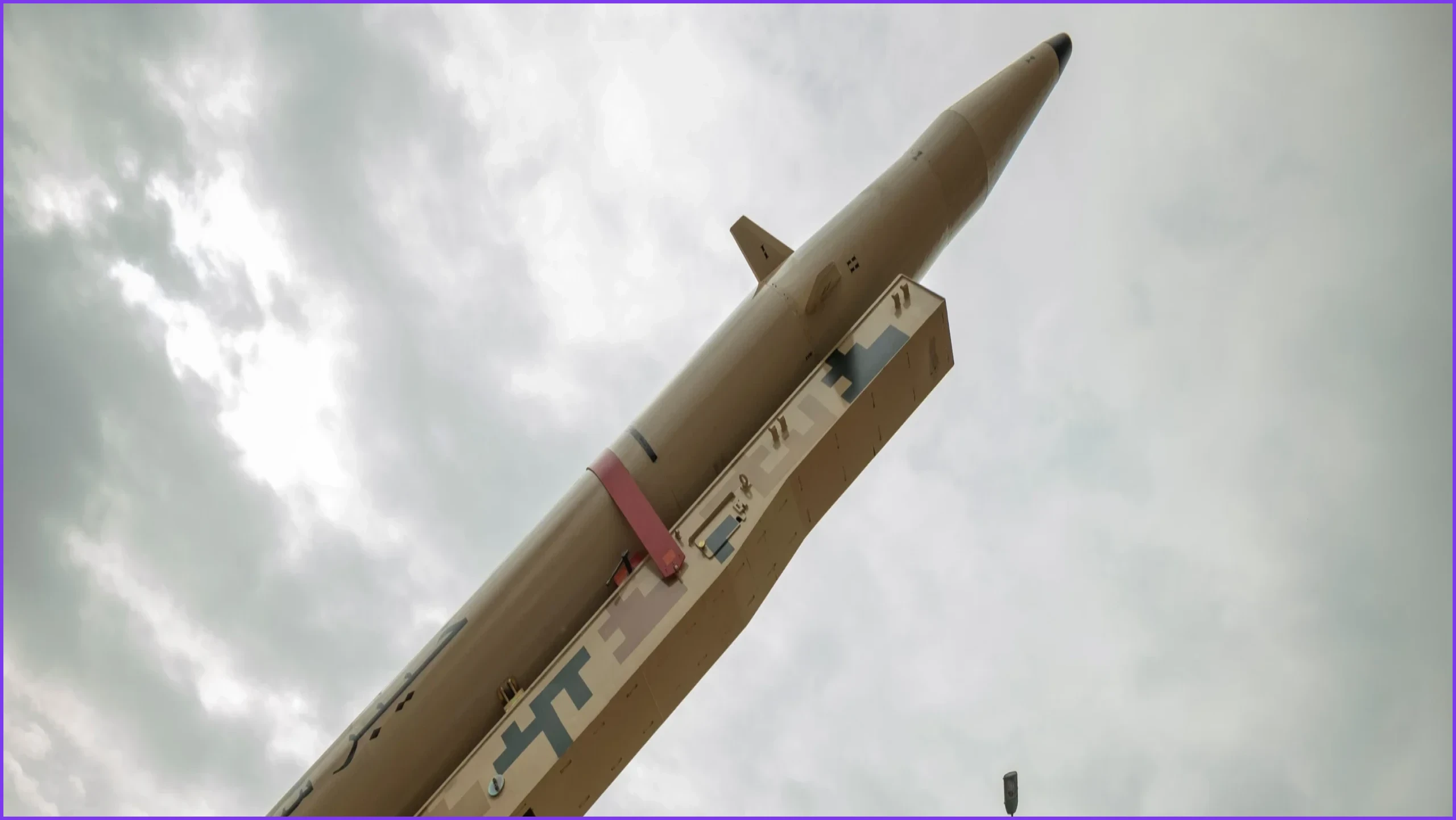
Iran has fielded a new generation of ballistic missiles that can evade American air defenses and strike with far greater precision, a technological leap that military experts say has damaged the ring of U.S. bases across the Persian Gulf and left them more vulnerable than they have been in decades. The centerpiece of that shift is a highly mobile ballistic missile Iran calls the Kheibar Shekan, or "Castle Breaker," which has a range of 900 miles and a satellite-guided, maneuverable warhead.
Iran's military has used the missile extensively in strikes on the U.S. naval hub in Bahrain and other American bases during the six-month war with the U.S. and Israel, according to the Iranian government and confirmed in interviews with former U.S. military and intelligence officials and weapons analysts. Some of those analysts believe Iran used Castle Breaker missiles in the July 17 strikes on the U.S. Muwaffaq Salti Air Base in Al-Azraq, Jordan, that killed three American service members, an assertion Iran itself has also made, according to official government statements.
On Aug. 31, an Iranian state-run outlet confirmed it used Kheibar Shekan missiles to hit Muwaffaq Salti and the King Hussein air base in Jordan in response to a U.S. military attack on Iran's Larak Island the previous night. Iran's Islamic Revolutionary Guard Corps (IRGC) targeted the technical and maintenance infrastructure as well as fighter-jet bases at the two facilities, causing significant damage, according to the IRGC-affiliated Tasnim News Agency.
Unlike a conventional ballistic missile that travels a fixed path defenders can track and try to intercept, the Kheibar Shekan can quickly change course in the final phase of its descent, potentially slipping past air defenses and hitting targets with devastating precision. Mounted on mobile launchers, the solid-fuel missile is extremely difficult to detect and destroy before launch, allowing it to survive American bombardment campaigns. It can easily reach U.S. and allied targets across the Middle East, including in Israel, and major American bases like Al Udeid Air Base in Qatar, Prince Sultan Air Base in Saudi Arabia, and the Al Dhafra Air Base in the United Arab Emirates.
Jonathan Hackett, a former Marine and U.S. intelligence officer, noted that the U.S. designed entire air defense systems based on an understanding of what they thought Iran would do, but now they are doing something different. Hackett and other experts described how the Kheibar Shekan and other Iranian missiles have on occasion penetrated the layered defenses American forces have relied on for generations during the war against Tehran that President Donald Trump launched jointly with Israel six months ago. Hackett believes Kheibar missiles were central to the July 17 strike, though he noted that U.S. officials have made that hard to corroborate by asking major commercial satellite providers to black out imagery of sensitive U.S. military sites in the region.
An independent analysis of satellite imagery conducted by The Washington Post revealed that Iranian missile and drone strikes damaged or destroyed at least 228 structures and pieces of equipment across at least 15 U.S. military sites in the Middle East during the conflict. Top administration officials, including Pentagon chief Pete Hegseth and Trump himself, have insisted that the U.S. campaign has destroyed Iran’s military capabilities and that U.S. air defenses have been successful the majority of the time, an assertion Iran vehemently denies. Pentagon Spokesman Sean Parnell stated in an Aug. 28 statement that U.S. forces remain fully operational and have already executed successful operations while maintaining a deep, ready arsenal to defend people and interests. Deputy Pentagon Press Secretary Joel Valdez said he had nothing further to add on the matter, and the Pentagon did not respond to requests for comment on Aug. 31 about whether the Castle Breaker broke through U.S. defenses during the overnight exchange of military strikes.
The threat from the relatively new Iranian technology helped prompt a public reckoning earlier this month, when retired four-star Army Gen. Barry McCaffrey stated on X that the United States had probably permanently lost access to 15 Persian Gulf bases because of Iranian missile and drone strikes. McCaffrey’s Aug. 22 post has drawn more than 3.8 million views, sparking a debate in U.S. military and intelligence circles over whether the Trump administration had sufficiently accounted for Iran's missile counterpunch before launching an unprovoked war. McCaffrey, who served in the U.S. Army for 32 years and is highly decorated, led 26,000 troops into battle in Operation Desert Storm. He has been a prominent military analyst and critic of the war in Iran.
McCaffrey was responding to a statement on X that Iranian counterattacks had all but destroyed the Bahrain base, which is the primary anchor for U.S. naval power in the Persian Gulf region. As a result of that counterattack and others like it, McCaffrey wrote that Iran is now poised to control access to the Gulf States, and the U.S. will have to negotiate new access in western Saudi Arabia, Israel, and southern Europe. In interviews, McCaffrey said the Iranian missile capability, especially the Kheibar Shekan, is central to his conclusion that U.S. bases in the Gulf are too vulnerable to stay where they are. The missile is particularly agile, well-hidden by Iran, and something that U.S. military installations in the region cannot completely defend against. Its capabilities amount to a significant change in technology, he said, noting that as it starts reentry, it can change the impact point, which clearly complicates U.S. military calculations on how to hit it using advanced U.S. missile defense systems. All it takes is one, two, or three of them getting through, and suddenly there is a potentially catastrophic impact.
Both McCaffrey and Hackett said the Kheibar Shekan and other Iranian missiles, combined with Iran's aggressive use of sophisticated drones, have caused considerable damage to U.S. Army, Navy, and Air Force bases and smaller encampments throughout the Middle East. A review of congressional research, defense assessments, and the public record supports that assessment. McCaffrey said Iran's Kheibar strikes on Israel in 2024 were largely ineffective, but newer versions of it have caused extensive damage in the current war that the Pentagon has not acknowledged. That includes U.S. radar and tactical communications systems, missile-defense nodes, air-to-air refuelers, Airborne Warning and Control System (AWACS) planes, and other expensive aircraft that were destroyed while parked on an airfield. McCaffrey noted that the Iranians fired 6,000 drones and ballistic missiles and the U.S. intercepted 1,500, meaning a bunch of them got through and did immense damage.
The U.S. vulnerability to Iranian missiles is not a secret; the Pentagon and U.S. intelligence agencies have known about it for decades and quietly judged it to be manageable. But then Trump provoked Iran into counterattacking after launching the war on Feb. 28. Within minutes, Tehran began unleashing its arsenal against military and government targets throughout the region. It has been obvious for decades that you can go in and conduct operations in the Gulf only if the Iranians do not try and stop you, McCaffrey said. He said Iran's response in this war has been devastating not only to U.S. military bases in the region but also to the U.S. allies who host them, prompting a wholesale reassessment of whether the bases are more sitting ducks than geostrategic military hubs going forward. A Wall Street Journal investigation concurred, saying in a June 25 report that the extensive damage from Iranian missiles and drones has the U.S. re-evaluating its entire footprint in the region.
Iran first introduced the Kheibar Shekan, which translates to "Breaker of the Kheibar" in reference to a historical fortified oasis in the Arabian Peninsula, in 2022. Jim Lamson, a CIA analyst from 1998 to 2021, said the Kheibar Shekan’s guidance system allows it to adjust its trajectory and maneuver rapidly to strike within 10 meters of a target, a significant achievement given how far it travels. Its ability to maneuver in the terminal phase means it can completely avoid two or three interceptors fired at it by opposing military forces, Lamson, who now tracks Iran's missile program as a senior research associate at the James Martin Center for Nonproliferation Studies, said. Since 2024, Iran has stacked on incremental improvements, likely with the help of Chinese and Russian technology, to make the missile a particularly lethal threat to the 30,000 to 40,000 U.S. troops in the region, Lamson said. The updates include improved satellite guidance, altered launch trajectories that are harder for missile-defense radar to predict, better resistance to electronic jamming, and coordinated barrages that mix ballistic missiles with swarms of drones. At the same time, U.S. defenses have been degraded, both by Iranian attacks on the United States and allied radar and air-defense sites across the region and as Washington depleted its own interceptor stockpiles, according to Lamson, McCaffrey, and Hackett.
Most of Iran’s missiles are still getting intercepted, Hegseth said in a July hearing of the Senate Appropriations Committee. At that hearing, Democrats demanded to know why Iran was able to inflict so much damage on U.S. bases. Hegseth had stated months earlier that the administration had succeeded in its military campaign to obliterate Iran’s missile threat. We never expected they would stop having capabilities to shoot, Hegseth testified. The question is at scale against an opponent like the United States of America. But Lamson, McCaffrey, and Hackett said enough missiles are getting through to significantly damage U.S. bases and the infrastructure of U.S. allies in the region like Jordan, Bahrain, and Saudi Arabia. They have been able to adapt both technologically and operationally and tactically to improve their effectiveness against the U.S. and to effectively exploit U.S. vulnerabilities in order to be able to sustain the conflict against the U.S. and not surrender, Lamson said.
On July 17, Iranian ballistic missiles and drones hit the massive Muwaffaq Salti Air Base in Jordan. Two soldiers were killed in the attack: Pvt. Isabella Gonzales, 19, of Carrollton, Texas, and 1st Lt. Tyler James Feehan, 25, of Ewa Beach, Hawaii, U.S. Central Command said. The Pentagon said on July 21 it had identified the remains of a third soldier who was believed to have died in the attack, Sgt. Angel S. Rampersad, a signal operations support specialist. Gonzales and Feehan were active-duty soldiers supporting Operation Inherent Resolve, which assists partner forces in securing a lasting defeat of ISIS. Commercial satellite imagery captured days later showed the scale of the attack. There were multiple impact sites, two aircraft hangars were struck and likely destroyed, and drone facilities were hit, and the images showed heavy damage to housing units where service members slept. Follow-up Iranian missile strikes were reported later that month.
Hackett, who once worked out of the U.S. embassy in Jordan, described the July 17 strike as a live combat test of the Kheibar Shekan against U.S. bases in Jordan. He said the Kheibar is especially dangerous because its maneuverability allows it to strike dynamic targets, including people and military assets that moved at the last minute to dodge them. That includes valuable aircraft and these huge fuel bladders sitting around with tons of jet fuel in them. These can be struck now by this weapon and cause mass explosions and casualties. The three analysts agreed that it cannot be ascertained with specificity how much damage Iranian missiles like the Kheibar Shekan have done to U.S. and allied interests in the region, given the Pentagon’s lack of transparency about the strikes. The more important fact is that there has been this implication that Israel, Jordan, and Saudi Arabia are safe, along with other U.S. allies that host American bases like Qatar and Bahrain, McCaffrey said. And obviously they are not.