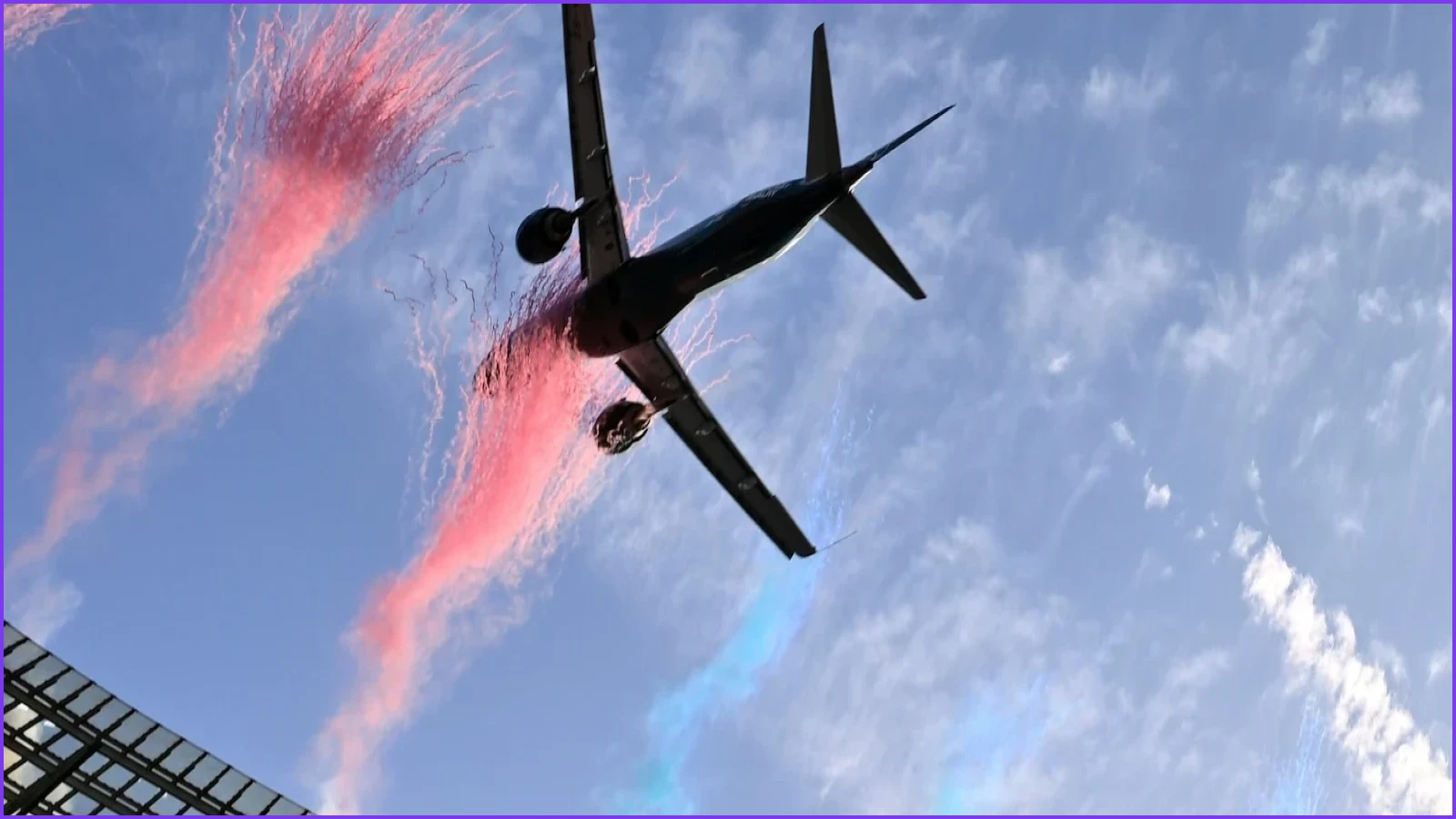
A pregame exhibition involving two passenger jets flying at remarkably low altitudes over a sports stadium in South Africa has ignited a significant international debate regarding safety risks. The spectacle, which took place on Saturday before a high-profile rugby match between South Africa and New Zealand at Cape Town Stadium, drew massive cheers from an estimated crowd of 56,000 spectators.
Flight tracking data from Flightradar24 suggests that the lead jet passed between 41 and 46 feet (12 to 14 meters) above the roof of the stadium, where both the crowd and the world's top-ranked rugby teams were positioned. A second jet followed closely behind, passing through a cloud of pink dust that had been deployed from the stadium roof as part of the pregame festivities.
The airline responsible for the stunt, local carrier Airlink, stated that the operation was meticulously planned and rehearsed. According to the airline, each of the two Embraer jets—which were not carrying passengers—was crewed by three senior captains assigned to the roles of commander, co-pilot, and safety officer. The aircraft were moving at approximately 150 knots (278 kph or 172 mph) during the flyby.
In a statement issued on Sunday, Airlink acknowledged the concerns raised across social media and online forums. The airline emphasized that the maneuver required careful coordination and received guidance, approval, and support from the South African Civil Aviation Authority and Air Traffic Navigation Services. Airlink further maintained that flight data confirmed the jets operated within civil aviation safety limits for both speed and altitude.
Stadium flybys have become a tradition in South African rugby, dating back to a notable Boeing 747 appearance before the 1995 Rugby World Cup final. However, this weekend's event was uniquely low, prompting a surge of witness videos and global attention. This visibility has led some aviation experts to question whether the margin for error was dangerously narrow.
Chris Martinus, president of the Aircraft Owners and Pilots Association South Africa, described the maneuver as uncomfortable, noting that the lead aircraft appeared to be navigating the stadium's architecture at an altitude that left no room for error. He warned that at such heights, pilots have virtually no options if an adverse event occurs. Similarly, Australian aviation consultant Keith Tonkin, a former military and commercial pilot, cautioned that Embraer regional jets are not designed for such low-level operations. Tonkin expressed concern that the stunt establishes a dangerous precedent, warning that factors like turbulence or a bird strike could have resulted in a catastrophic outcome given the lack of maneuvering room.